- Space
- Astronomy
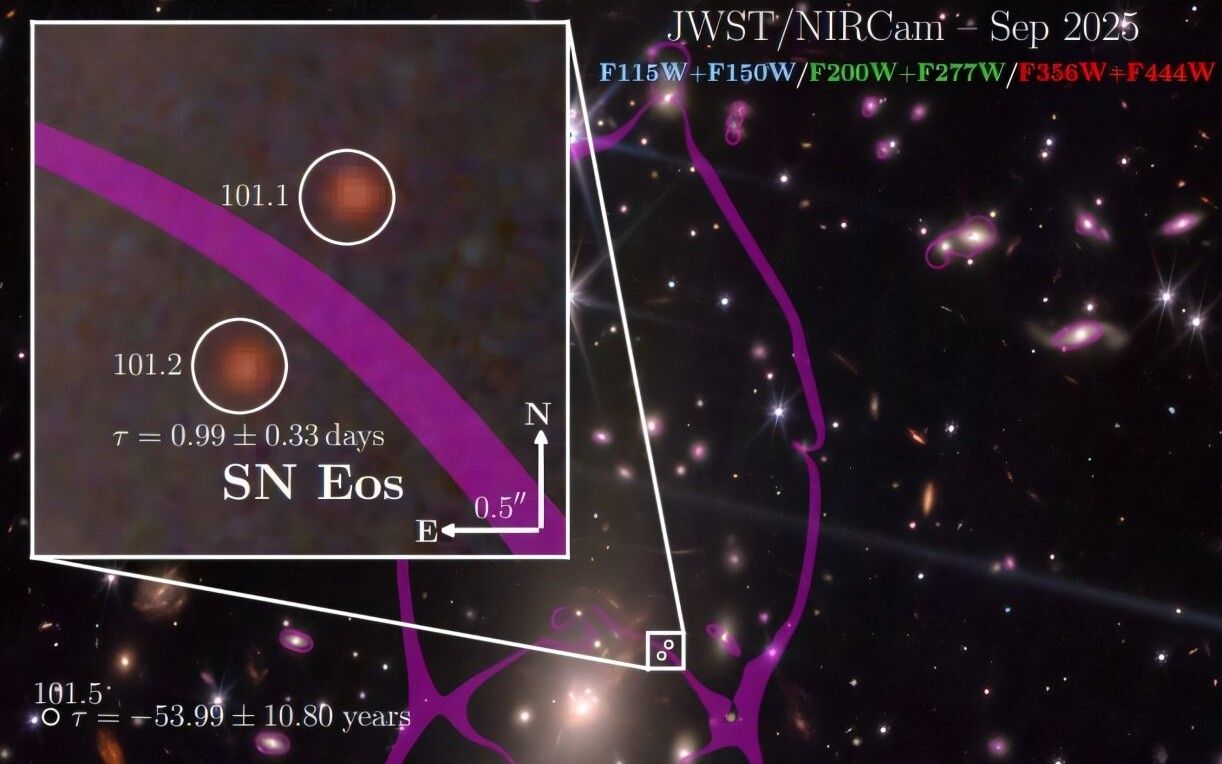
An extremely early Type II supernova explosion, named after the Titan goddess of dawn in Greek mythology, occurred just 1 billion years after the Big Bang.
When you purchase through links on our site, we may earn an affiliate commission. Here’s how it works.
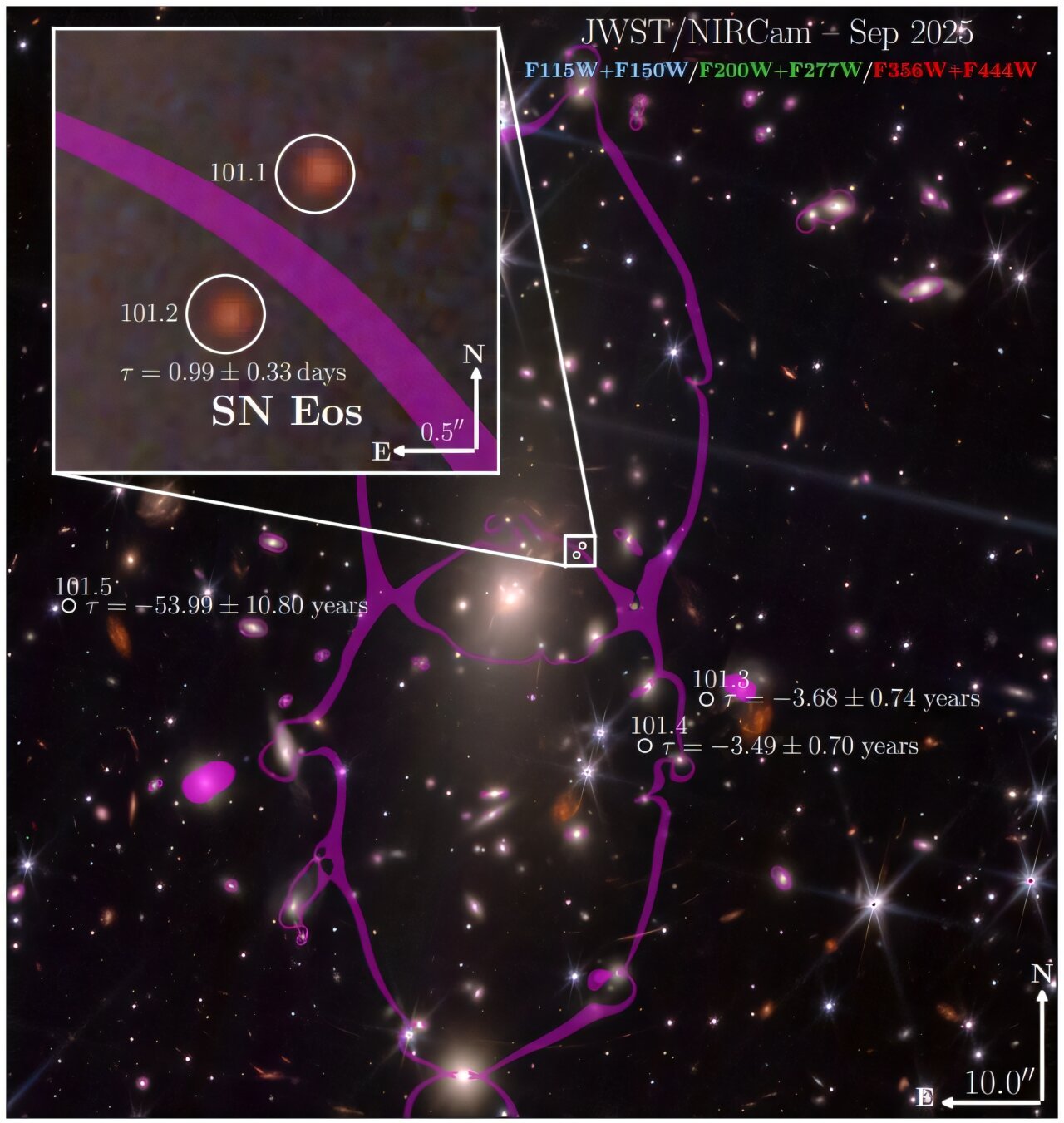
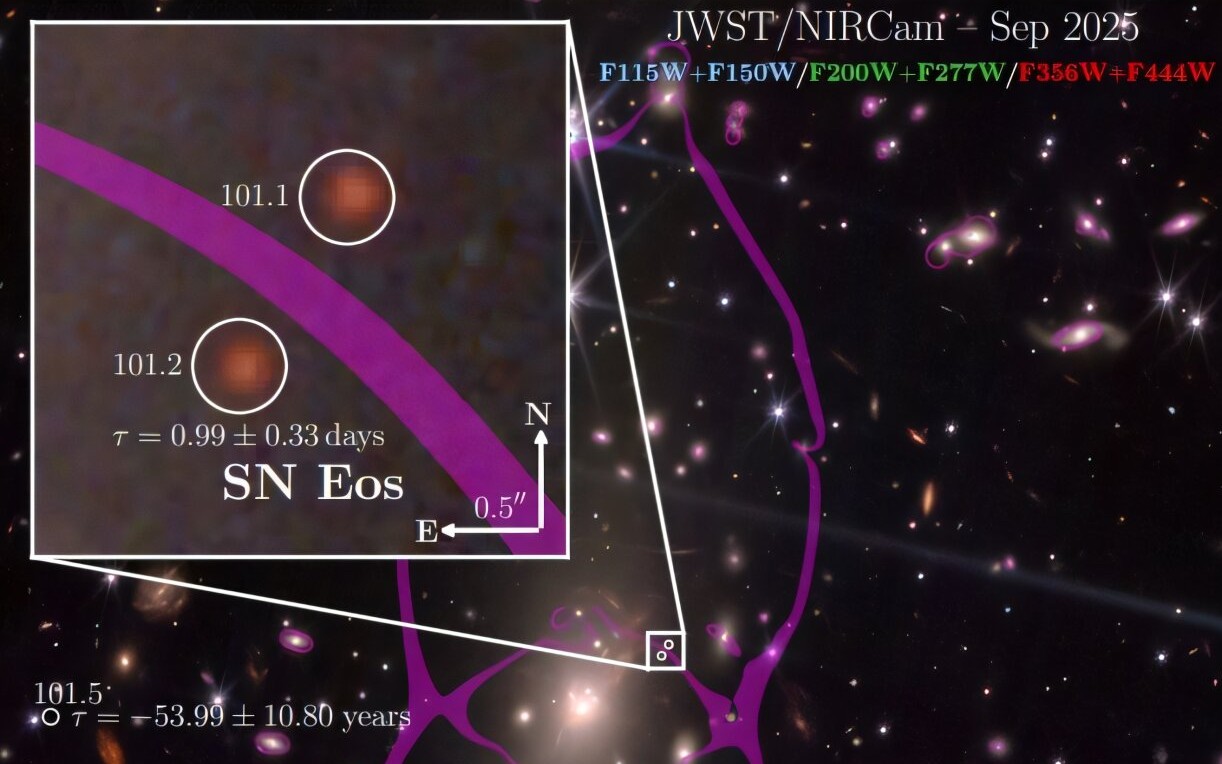 SN Eos, the earliest Type II supernova in the known universe, was discovered through gravitational lensing, causing the bright blast to appear magnified and repeated in James Webb telescope observations.
(Image credit: Coulter et al. / JWST)
Share
Share by:
SN Eos, the earliest Type II supernova in the known universe, was discovered through gravitational lensing, causing the bright blast to appear magnified and repeated in James Webb telescope observations.
(Image credit: Coulter et al. / JWST)
Share
Share by:
- Copy link
- X
Scientists have spotted a distant supernova unleashed by a collapsing star just 1 billion years after the birth of the universe.
The James Webb Space Telescope (JWST) captured images of the Type II supernova on Sept. 1 and Oct. 8, 2025. Dubbed "Eos," after the Titan goddess of dawn in Greek mythology, the supernova will help scientists understand how stars and galaxies evolve over billions of years, researchers reported Jan. 7 on the preprint server arXiv.
You may like-
 James Webb telescope may have spotted the earliest supernova in the universe
-
 Rarrr! James Webb telescope spots 'monster stars' leaking nitrogen in the early universe
-
 'Puzzling' object discovered by James Webb telescope may be the earliest known galaxy in the universe
Deaths of the earliest stars
A supernova occurs when a massive star explodes at the end of its life. Type I supernovas include those that have no hydrogen in their spectra, while Type II supernovas show some evidence of hydrogen. Regardless of the type, supernovas aren't very common; just two to three occur per century in galaxies the size of the Milky Way.
In the new study, scientists used a phenomenon known as gravitational lensing to capture images of the distant supernova. Gravitational lensing occurs when light passes through an area of space-time that's been warped by the immense gravity of a massive object, such as a black hole or galaxy cluster. The distortion magnifies that light, allowing scientists to spot objects that would be too dim to see otherwise.
The supernova was rich in hydrogen, and its star exploded in an environment that held a very low concentration of elements heavier than hydrogen. In fact, the progenitor star likely had less than 10% of these heavier elements than our own sun does, the team found. This apparent lack of heavy elements further confirms the supernova's extremely early age, as stellar fusion had yet to fill the universe with plentiful heavy elements.
Sign up for the Live Science daily newsletter nowContact me with news and offers from other Future brandsReceive email from us on behalf of our trusted partners or sponsorsBy submitting your information you agree to the Terms & Conditions and Privacy Policy and are aged 16 or over.By analyzing the ultraviolet light from the burst, the researchers determined that Eos is a Type II-P supernova. The light from a Type II-P supernova remains bright for a while after it peaks, before slowly fading out. (In contrast, Type II-L supernovas dim steadily over time.) Eos is likely near the end of its brightness plateau, the team found.
related stories— James Webb telescope spots earliest black hole in the known universe, looking 'as far back as you can practically go'
— James Webb telescope finds supermassive black hole hidden inside 'Jekyll and Hyde' galaxy
— James Webb telescope finds something 'very exciting' shooting out of first black hole ever imaged
Scientists still need to observe more early supernovas to confirm if Eos' properties are typical for massive stars and supernovas of the epoch. But those findings could help scientists chart the evolution of stars and galaxies from the early universe to today.
"The discovery of SN Eos represents a critical step toward fulfilling JWST's core mission objectives of understanding the lives and deaths of the first stars, the origins of the elements, and the assembly and evolution of the youngest galaxies," the researchers wrote.
 Skyler WareSocial Links NavigationLive Science Contributor
Skyler Ware is a freelance science journalist covering chemistry, biology, paleontology and Earth science. She was a 2023 AAAS Mass Media Science and Engineering Fellow at Science News. Her work has also appeared in Science News Explores, ZME Science and Chembites, among others. Skyler has a Ph.D. in chemistry from Caltech.
Show More CommentsYou must confirm your public display name before commenting
Please logout and then login again, you will then be prompted to enter your display name.
Logout Read more James Webb telescope may have spotted the earliest supernova in the universe
 Rarrr! James Webb telescope spots 'monster stars' leaking nitrogen in the early universe
 'Puzzling' object discovered by James Webb telescope may be the earliest known galaxy in the universe
 James Webb telescope may have discovered the earliest, most distant black hole ever seen
 'Not so exotic anymore': The James Webb telescope is unraveling the truth about the universe's first black holes
 'A real revolution': The James Webb telescope is upending our understanding of the biggest, oldest black holes in the universe
Latest in Astronomy
'A real revolution': The James Webb telescope is upending our understanding of the biggest, oldest black holes in the universe
Latest in Astronomy
 An ocean the size of the Arctic once covered half of Mars, new images hint
 Stunning time-lapse video captured using 'artificial eclipse' shows 3 massive eruptions on the sun
 Scientists see monster black hole 'reborn' after 100 million years of rest
 Earth hit by biggest 'solar radiation storm' in 23 years, triggering Northern Lights as far as Southern California
 James Webb telescope reveals sharpest-ever look at the edge of a supermassive black hole
 Strange discovery offers 'missing link' in planet formation
Latest in News
Strange discovery offers 'missing link' in planet formation
Latest in News
 Some of the oldest harpoons ever found reveal Indigenous people in Brazil were hunting whales 5,000 years ago
 'Pain sponge' derived from stem cells could soak up pain signals before they reach the brain
 Arctic blast probably won't cause trees to explode in the cold — but here's what happens if and when they do go boom
 Wegovy now comes in pill form — here's how it works
 'Earthquake on a chip' uses 'phonon' lasers to make mobile devices more efficient
 Creepy robotic hand detaches at the wrist before scurrying away to collect objects
LATEST ARTICLES
Creepy robotic hand detaches at the wrist before scurrying away to collect objects
LATEST ARTICLES- 1Some of the oldest harpoons ever found reveal Indigenous people in Brazil were hunting whales 5,000 years ago
- 2'A real revolution': The James Webb telescope is upending our understanding of the biggest, oldest black holes in the universe
- 3'Earthquake on a chip' uses 'phonon' lasers to make mobile devices more efficient
- 4Chocolate Hills: The color-changing mounds in the Philippines that inspired legends of mud-slinging giants
- 5How to choose the best dehumidifier for your home this season