- Space
- Astronomy
- Black Holes
Scientists saw an inactive black hole 'reawaken' from a 100-million-year nap with fire and fury.
When you purchase through links on our site, we may earn an affiliate commission. Here’s how it works.
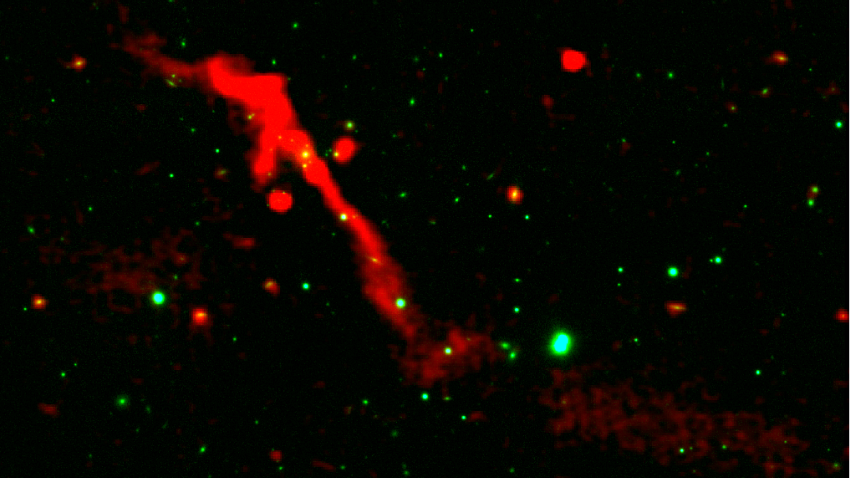
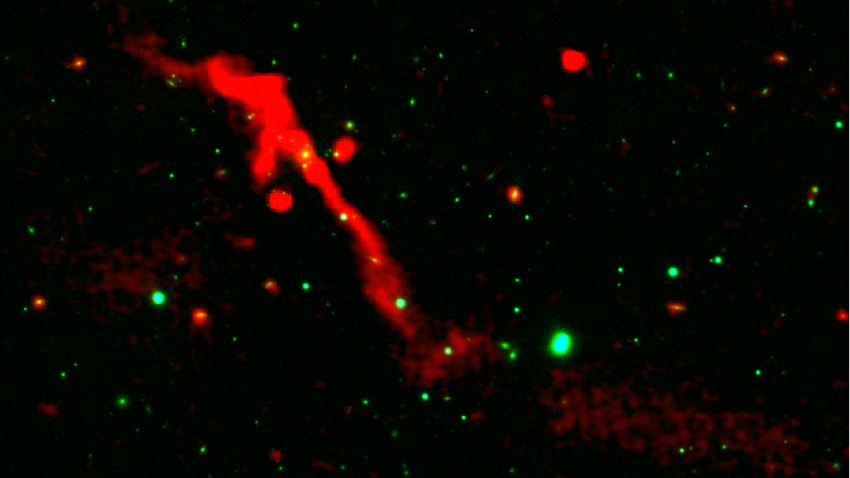 Seen as a ribbon of red radio emissions, a gigantic energy jet blasting out of a supermassive black hole tells the story of a reawakened monster.
(Image credit: LOFAR/Pan-STARRS/S. Kumari et al.)
Share
Share by:
Seen as a ribbon of red radio emissions, a gigantic energy jet blasting out of a supermassive black hole tells the story of a reawakened monster.
(Image credit: LOFAR/Pan-STARRS/S. Kumari et al.)
Share
Share by:
- Copy link
- X
Scientists have observed a supermassive black hole waking up from a nearly 100 million-year nap.
The black hole lies at the center of a gigantic galaxy that's emitting extremely strong radio waves. A new analysis of these radio emissions reveals the black hole once spewed gargantuan jets of plasma hundreds of thousands of light-years into space, before suddenly shutting off sometime in the distant past. Those jets are now active once again, and they are interacting in complex and chaotic ways with the superheated gas around them, according to the new study.
"It's like watching a cosmic volcano erupt again after ages of calm — except this one is big enough to carve out structures stretching nearly a million light-years across space," study co-author Shobha Kumari, an astronomer at Midnapore City College in India, said in a statement.
You may like-
 'A scale almost too big to imagine': Scientists spot monster black hole roaring with winds at more than 130 million mph
-
 'Unlike any we've ever seen': Record-breaking black hole eruption is brighter than 10 trillion suns
-
 'A real revolution': The James Webb telescope is upending our understanding of the biggest, oldest black holes in the universe
Galactic engine trouble
Only 10% to 20% of supermassive black holes have jets that emit radio signals. In these galaxies, a spinning disk of dust and plasma swirls around the black hole, regularly feeding it large amounts of matter. This infalling matter creates a tangled magnetic field that can fling some matter away from the black hole in giant jets. Changes in the disk can cause these radio jets to turn off and on in rare cases.
In the new study, published Jan. 15 in the journal Monthly Notices of the Royal Astronomical Society, the researchers used the Low-Frequency Array, a radio telescope network located primarily in the Netherlands, to find more than 20 galaxy clusters that housed radio galaxies with irregularly shaped jets. They focused on one such galaxy, called J1007+3540, with a particularly unusual footprint.
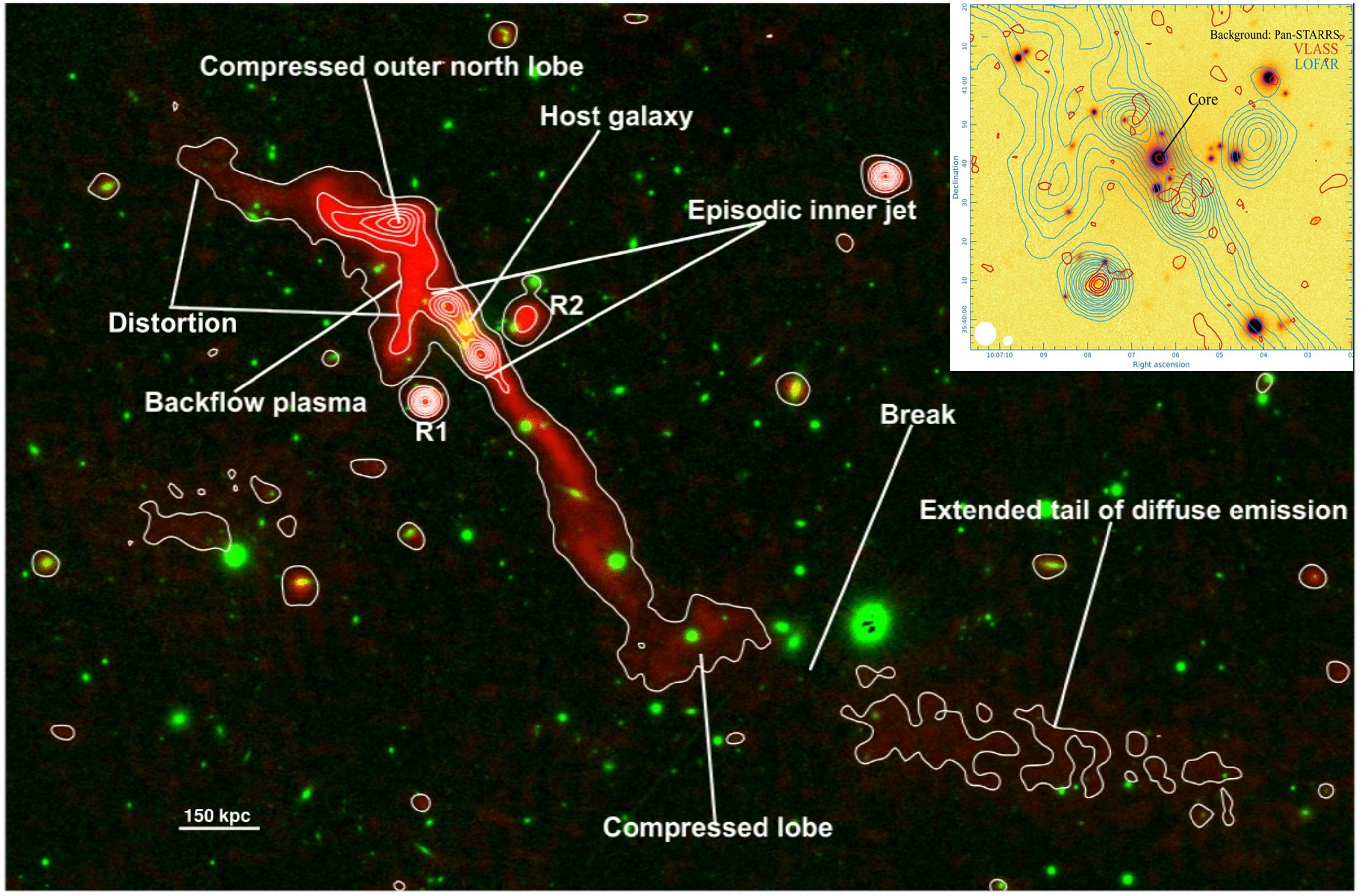
The giant galaxy has large, diffuse lobes of plasma that indicate past jet activity dating back some 240 million years. But within those lobes are smaller, brighter plasma jets that are just 140 million years old, the team found. That suggested that the active galactic nucleus (AGN) — the central region that houses a galaxy's supermassive black hole — had kicked back on after a period of silence.
"This dramatic layering of young jets inside older, exhausted lobes is the signature of an episodic AGN — a galaxy whose central engine keeps turning on and off over cosmic timescales," Kumari said.
Sign up for the Live Science daily newsletter nowContact me with news and offers from other Future brandsReceive email from us on behalf of our trusted partners or sponsorsBy submitting your information you agree to the Terms & Conditions and Privacy Policy and are aged 16 or over.related stories—'Very rare' black hole energy jet discovered tearing through a spiral galaxy shaped like our own
—'We were amazed': Astronomers discover oldest, biggest black hole jet in the known universe — and there may be more
—James Webb telescope finds something 'very exciting' shooting out of first black hole ever imaged
The space between the galaxies in the cluster that includes J1007+3540 is filled with superheated gas known as the intracluster medium. That gas interacts with the radio jets, bending and shaping them as they extend from the AGN. One of the two older lobes is squished sideways and back toward its source by the surrounding gas. The other lobe has a long, kinked tail that suggests the intracluster medium is interacting with the jets in a different way.
"J1007+3540 is one of the clearest and most spectacular examples of episodic AGN with jet-cluster interaction, where the surrounding hot gas bends, compresses, and distorts the jets," study co-author Surajit Pal, a physicist at the Manipal Centre for Natural Sciences in India, said in the statement.
Observing J1007+3540 will help researchers determine how often AGNs turn on and off and how old jets interact with their surroundings. In future work, the team plans to collect high-resolution observations of the galaxy to map how the jets propagate through the intracluster medium, according to the statement.
 Skyler WareSocial Links NavigationLive Science Contributor
Skyler Ware is a freelance science journalist covering chemistry, biology, paleontology and Earth science. She was a 2023 AAAS Mass Media Science and Engineering Fellow at Science News. Her work has also appeared in Science News Explores, ZME Science and Chembites, among others. Skyler has a Ph.D. in chemistry from Caltech.
Show More CommentsYou must confirm your public display name before commenting
Please logout and then login again, you will then be prompted to enter your display name.
Logout Read more 'A scale almost too big to imagine': Scientists spot monster black hole roaring with winds at more than 130 million mph
 'Unlike any we've ever seen': Record-breaking black hole eruption is brighter than 10 trillion suns
 'A real revolution': The James Webb telescope is upending our understanding of the biggest, oldest black holes in the universe
 'Not so exotic anymore': The James Webb telescope is unraveling the truth about the universe's first black holes
 James Webb telescope finds supermassive black hole hidden inside 'Jekyll and Hyde' galaxy
 Scientists spot 2 black holes that took turns slaughtering 1 unlucky star
Latest in Black Holes
Scientists spot 2 black holes that took turns slaughtering 1 unlucky star
Latest in Black Holes
 Some objects we thought were planets may actually be tiny black holes from the dawn of time
 James Webb telescope confirms a supermassive black hole running away from its host galaxy at 2 million mph, researchers say
'A real revolution': The James Webb telescope is upending our understanding of the biggest, oldest black holes in the universe
James Webb telescope finds supermassive black hole hidden inside 'Jekyll and Hyde' galaxy
'A scale almost too big to imagine': Scientists spot monster black hole roaring with winds at more than 130 million mph
Scientists spot 2 black holes that took turns slaughtering 1 unlucky star
Latest in News
James Webb telescope confirms a supermassive black hole running away from its host galaxy at 2 million mph, researchers say
'A real revolution': The James Webb telescope is upending our understanding of the biggest, oldest black holes in the universe
James Webb telescope finds supermassive black hole hidden inside 'Jekyll and Hyde' galaxy
'A scale almost too big to imagine': Scientists spot monster black hole roaring with winds at more than 130 million mph
Scientists spot 2 black holes that took turns slaughtering 1 unlucky star
Latest in News
 Some of the oldest harpoons ever found reveal Indigenous people in Brazil were hunting whales 5,000 years ago
 'Pain sponge' derived from stem cells could soak up pain signals before they reach the brain
 An ocean the size of the Arctic once covered half of Mars, new images hint
 Arctic blast probably won't cause trees to explode in the cold — but here's what happens if and when they do go boom
 Wegovy now comes in pill form — here's how it works
 'Earthquake on a chip' uses 'phonon' lasers to make mobile devices more efficient
LATEST ARTICLES
'Earthquake on a chip' uses 'phonon' lasers to make mobile devices more efficient
LATEST ARTICLES- 1Some of the oldest harpoons ever found reveal Indigenous people in Brazil were hunting whales 5,000 years ago
- 2'A real revolution': The James Webb telescope is upending our understanding of the biggest, oldest black holes in the universe
- 3'Earthquake on a chip' uses 'phonon' lasers to make mobile devices more efficient
- 4Chocolate Hills: The color-changing mounds in the Philippines that inspired legends of mud-slinging giants
- 5How to choose the best dehumidifier for your home this season