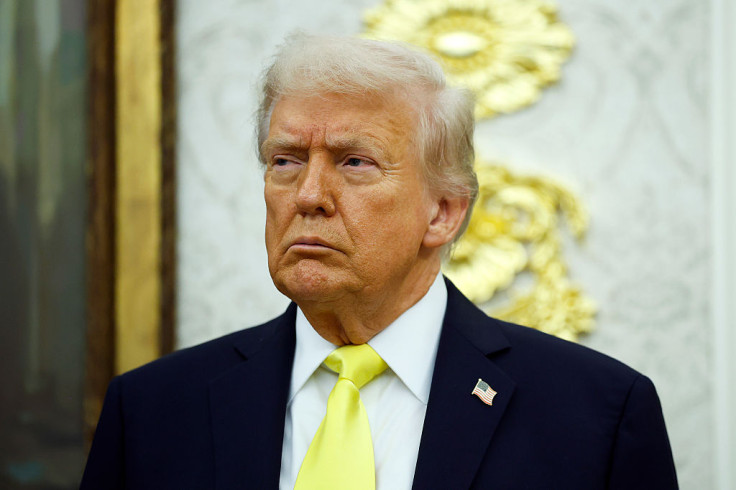
 President Donald Trump
Getty Images
President Donald Trump
Getty Images
Public opinion across much of Latin America has shifted toward greater acceptance of U.S. military intervention following the capture of Venezuelan leader Nicolás Maduro, according to multiple polls cited by The New York Times, marking a departure from the region's long-standing skepticism toward U.S. involvement.
While reactions varied by country, surveys conducted in the days after the operation showed majority support for the U.S. action in Peru, Chile, Colombia, Brazil, Argentina and Panama.
In Argentina, where the Venezuelan crisis has shaped political debate for more than a decade, a poll by Altica found that 61 percent of respondents supported the intervention, while 31 percent opposed it.
The reaction contrasted with the relatively muted protest activity across the region. Although some Latin Americans denounced what they described as U.S. imperialism, experts noted that left-wing movements struggled to mobilize against the removal of a leader widely blamed for economic collapse and mass migration.
"International law, imperialism — this is the discourse of the elite," said Marta Lagos, founder of the Latinobarómetro polling firm to The New York Times. Popular support for the intervention, she said, "has nothing to do with ideology. They choose whatever is possible to fix things."
The response in Mexico was more divided, reflecting stronger opposition to U.S. policy and a sizable left-wing base, the news outlet points out. President Claudia Sheinbaum rejected the intervention in a carefully worded statement, though broader regional leaders largely avoided direct confrontation with Washington.
Related-
Trump Acknowledges Use Of 'Sonic Weapon' During Raid To Capture Maduro: 'Nobody Else Has it'
-
French Citizen Held Prisoner In Venezuela Details Ordeal In Detention, Including Being Drugged And Sexually Attacked

-
Trump Shares AI-Altered Map with Canada, Greenland, Venezuela as Part of the U.S.

European public opinion, by contrast, has leaned sharply against the operation. Polling in Germany conducted the week after the capture found that 72 percent of respondents considered the U.S. military action unjustified, with majorities favoring a clear condemnation by Germany and the European Union. In Britain, a YouGov survey during the same time showed 51 percent disapproval of the raid, compared with just 21 percent approval.
Analysts said geography and proximity mattered, mainly because Venezuela's collapse has directly affected neighboring countries, which have absorbed millions of migrants fleeing shortages, repression and crime. Nearly seven million Venezuelans have resettled elsewhere in Latin America, according to the Migration Policy Institute.
"Maduro turned out to be the neighbor who is noisy and disruptive," said Patricio Navia, a political scientist at New York University. "So when the police came to pick him up they were like: 'finally.'"
Steven Levitsky, a Harvard political scientist, added that the region's response also reflects generational change. "Many Latin Americans don't remember" the Cold War-era interventions that shaped earlier anti-American sentiment, he said.
As concerns over crime, migration and economic instability dominate public life, experts said many in the region appear willing to tolerate extraordinary measures. "Latin Americans don't like a U.S. invasion," Navia said, "but they dislike economic crises and humanitarian crises even more."
© 2025 Latin Times. All rights reserved. Do not reproduce without permission.
Tags: Venezuela, Nicolas Maduro, Latin America, Argentina, Europe, Mexico, Trump administration, US military