- Physics & Mathematics
- Particle Physics
Astronomers found evidence that dark matter and neutrinos may interact, hinting at a "fundamental breakthrough" that challenges our understanding of how the universe evolved.
When you purchase through links on our site, we may earn an affiliate commission. Here’s how it works.
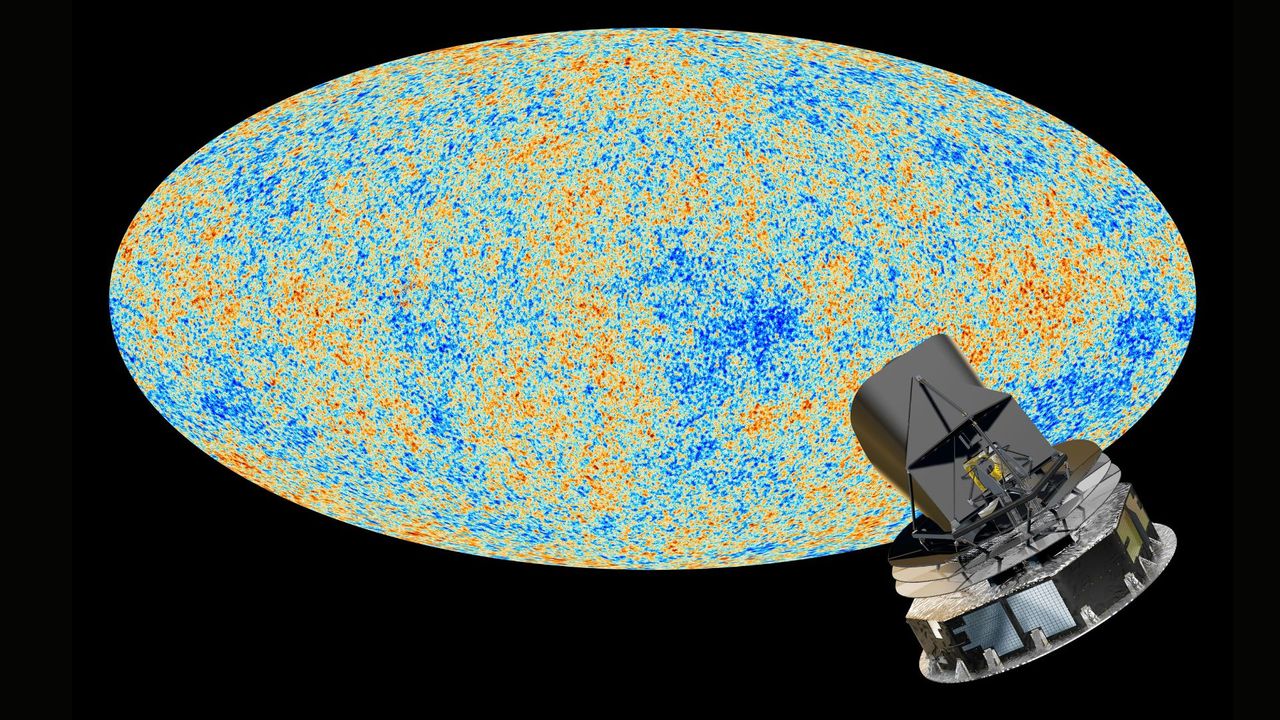
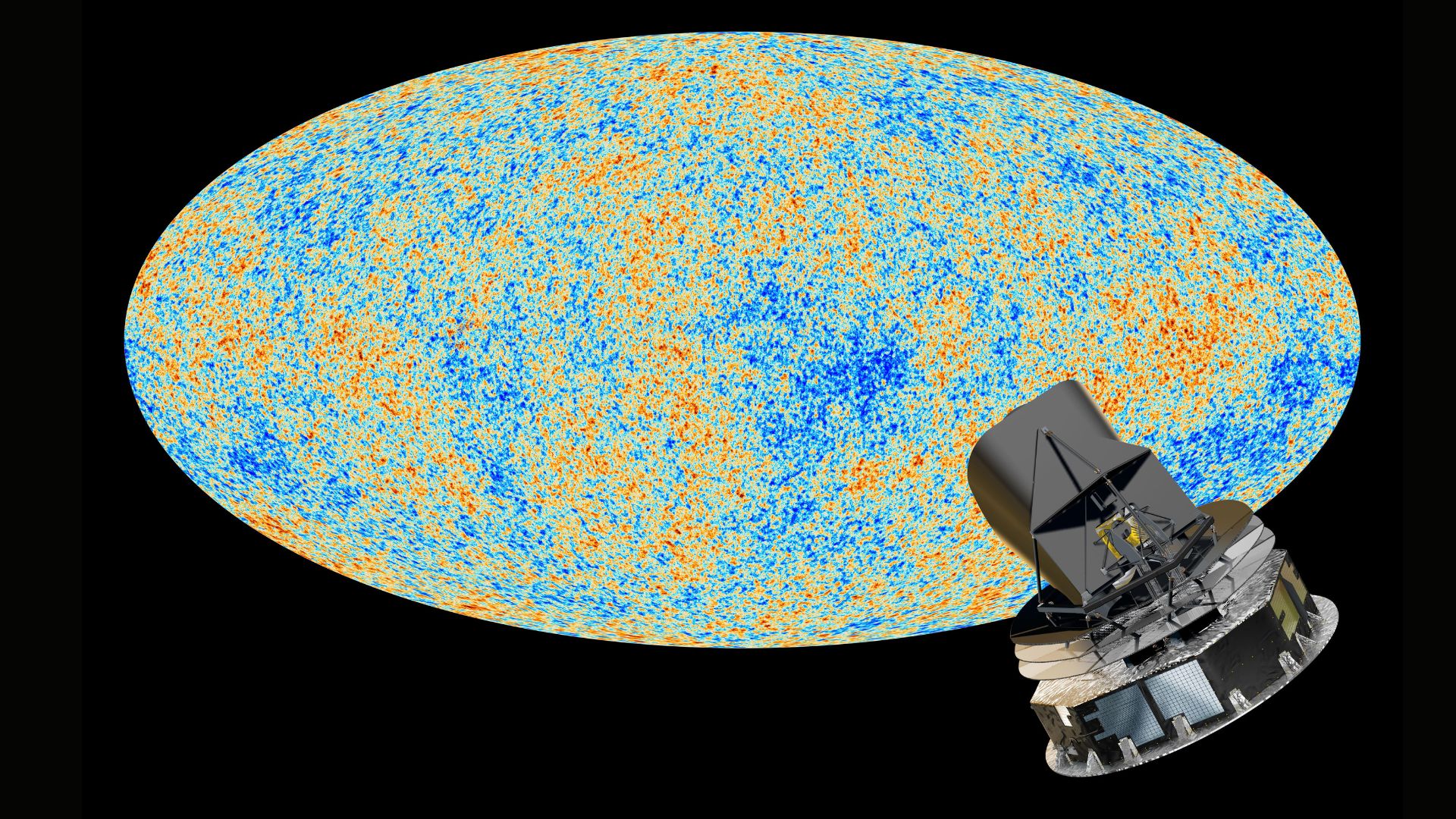 The cosmic microwave background is the oldest light in the universe. Imprinted on the sky when the universe was just 380,000 years old, it seeded every cosmic structure we see today.
(Image credit: ESA and the Planck Collaboration - D. Ducros)
Share
Share by:
The cosmic microwave background is the oldest light in the universe. Imprinted on the sky when the universe was just 380,000 years old, it seeded every cosmic structure we see today.
(Image credit: ESA and the Planck Collaboration - D. Ducros)
Share
Share by:
- Copy link
- X
Two of the universe's most mysterious particles may be colliding invisibly throughout the cosmos — a discovery that could solve one of the biggest lingering problems in our standard model of cosmology.
Those two elusive components — dark matter and neutrinos (or "ghost particles") — are ubiquitous throughout the cosmos, yet they remain poorly understood. In a study published Jan. 2 in the journal Nature Astronomy, an international team of researchers found evidence that dark matter and neutrinos may collide, transferring momentum between them in the process.
This surprising interaction may help to explain why the universe is less populated by dense regions, like galaxies, than predicted — in other words, the universe is less "clumpy" than cosmologists think it should be, the researchers said in a statement.
You may like-
 Historic search for 'huge missing piece' of the universe reveals new secrets of particle physics
-
 Did a NASA telescope really 'see' dark matter? Strange gamma-rays spark bold claims, but scientists urge caution
-
 Our model of the universe is deeply flawed — unless space is actually a 'sticky' fluid
Dark matter and neutrinos remain a riddle
Dark matter is the mysterious, invisible substance that constitutes 85% of the matter in the universe. As its name suggests, dark matter does not emit light, so its existence has been only indirectly inferred from its gravitational influence, as observed in cosmological surveys.
Neutrinos are subatomic particles with infinitesimally low masses and no electric charge, so they very rarely interact with other particles. They're produced by various nuclear processes, including stellar fusion and supernovas, in prodigious quantities: Every second, approximately 100 billion neutrinos pass through each square centimeter of your body, Live Science previously reported.
Yet dark matter and neutrinos should not interact, according to the leading model of cosmology, known as the lambda cold dark matter model (lambda-CDM). This standard model aims to theoretically explain the large-scale structure of the cosmos.
Cosmological conundrum
However, this recent study provides new evidence that dark matter and neutrinos may interact after all, as other researchers have posited over the past two decades.
Sign up for the Live Science daily newsletter nowContact me with news and offers from other Future brandsReceive email from us on behalf of our trusted partners or sponsorsBy submitting your information you agree to the Terms & Conditions and Privacy Policy and are aged 16 or over.If dark matter and neutrinos do collide, and transfer momentum to one another in the process, this discovery would inspire a rethink of the lambda-CDM model. Such collisions could also help to explain the "S8 tension," a mismatch between the expected and actual "clumpiness" of the universe.
"This tension does not mean the standard cosmological model is wrong, but it may suggest that it is incomplete," Eleonora Di Valentino, study co-author and a senior research fellow at the University of Sheffield in the U.K., explained in the statement. "Our study shows that interactions between dark matter and neutrinos could help explain this difference, offering new insight into how structure formed in the Universe."
The mismatch stems from researchers' findings that the current cosmos isn't as packed together as predicted, based on observations of the cosmic microwave background (CMB) — the first light in the universe, emitted when the cosmos was only 380,000 years old.
You may like-
Historic search for 'huge missing piece' of the universe reveals new secrets of particle physics
-
Did a NASA telescope really 'see' dark matter? Strange gamma-rays spark bold claims, but scientists urge caution
-
Our model of the universe is deeply flawed — unless space is actually a 'sticky' fluid
"The statement that cosmic structures are 'less clumped' is best understood in a statistical sense, rather than as a change in the appearance of individual galaxies or clusters. It refers to a reduced efficiency in the growth of cosmic structures over time," study co-author William Giarè, a cosmologist at the University of Hawaii, told Live Science via email.
Unraveling multiple threads of evidence
The researchers tried to unite evidence from energy and density fluctuations in the CMB and from baryon acoustic oscillations (BAO) — pressure waves "frozen" in time from the beginning of the cosmos — with more recent observations of the universe's large-scale structure.
The early-universe data come from the Atacama Cosmology Telescope in Chile and the European Space Agency's space-based Planck telescope, which was designed to study the CMB. The later-universe data come from the Victor M. Blanco Telescope in Chile and the Sloan Digital Sky Survey, a two-decade effort to create a 3D map of millions of galaxies across more than 11 billion light-years.
The researchers also incorporated cosmic shear data from the Dark Energy Survey. Cosmic shear is the distortion of distant celestial objects due to weak gravitational lensing, which occurs when massive foreground structures bend the fabric of space-time and alter the paths of light traveling from those distant celestial objects to our detectors.
Finally, the researchers combined these data and modeled the evolution of the universe. When accounting for collisions between dark matter and neutrinos and the resulting momentum exchange, the simulations generated a model universe that better agrees with real observations.
related stories—Heaviest antimatter particle ever discovered could hold secrets to our universe's origins
—Astronomers propose making a neutrino detector out of the Pacific Ocean
—Evidence for Stephen Hawking's unproven black hole theory may have just been found — at the bottom of the sea
There's reason to remain cautious, however, as the interaction between dark matter and neutrinos has only a 3-sigma level of certainty — meaning there is a 0.3% chance that this result is a fluke. Though short of the scientific gold standard of 5 sigma, it is significant enough to warrant additional research because, if confirmed, the interaction would prove a "fundamental breakthrough in cosmology and particle physics" — and a potential solution to the cosmic clumpiness quandary.
"The final verdict will come from upcoming large sky surveys, such as those from the Vera C. Rubin Observatory, and more precise theoretical work," research team leader Sebastian Trojanowski, a theoretical physicist at the National Centre for Nuclear Research in Poland, explained in a separate statement. "These will allow us to determine whether we are witnessing a new discovery in the dark sector or whether our cosmological models require further adjustment. However, each of these scenarios brings us closer to solving the mystery of dark matter."
Article SourcesZu, L., Giarè, W., Zhang, C. et al. A solution to the S8 tension through neutrino–dark matter interactions. Nat Astron (2026). https://doi.org/10.1038/s41550-025-02733-1
Ivan FarkasLive Science ContributorIvan is a long-time writer who loves learning about technology, history, culture, and just about every major “ology” from “anthro” to “zoo.” Ivan also dabbles in internet comedy, marketing materials, and industry insight articles. An exercise science major, when Ivan isn’t staring at a book or screen he’s probably out in nature or lifting progressively heftier things off the ground. Ivan was born in sunny Romania and now resides in even-sunnier California.
Show More CommentsYou must confirm your public display name before commenting
Please logout and then login again, you will then be prompted to enter your display name.
Logout Read more Historic search for 'huge missing piece' of the universe reveals new secrets of particle physics
 Did a NASA telescope really 'see' dark matter? Strange gamma-rays spark bold claims, but scientists urge caution
 Our model of the universe is deeply flawed — unless space is actually a 'sticky' fluid
 30 models of the universe proved wrong by final data from groundbreaking telescope
 Hubble telescope discovers 'Cloud-9,' a dark and rare 'failed galaxy' that's unlike anything seen before
 Record-breaking black hole collision finally explained
Latest in Particle Physics
Record-breaking black hole collision finally explained
Latest in Particle Physics
 Science history: Richard Feynman gives a fun little lecture — and dreams up an entirely new field of physics — Dec. 29, 1959
Historic search for 'huge missing piece' of the universe reveals new secrets of particle physics
Science history: Richard Feynman gives a fun little lecture — and dreams up an entirely new field of physics — Dec. 29, 1959
Historic search for 'huge missing piece' of the universe reveals new secrets of particle physics
 World's largest neutrino detector starts up — with incredible results
 For the first time, physicists peer inside the nucleus of a molecule using electrons as a probe
 What are the 'magic numbers' in nuclear physics?
 Why does the universe exist?
Latest in News
Dark matter and neutrinos may interact, hinting at 'fundamental breakthrough' in particle physics
Why does the universe exist?
Latest in News
Dark matter and neutrinos may interact, hinting at 'fundamental breakthrough' in particle physics
 Lab mice that 'touch grass' are less anxious — and that highlights a big problem in rodent research
 Californians have been using far less water than suppliers estimated — what does this mean for the state?
 Coyote scrambles onto Alcatraz Island after perilous, never-before-seen swim
 Enormous freshwater reservoir discovered off the East Coast may be 20,000 years old and big enough to supply NYC for 800 years
 2.6 million-year-old jaw from extinct 'Nutcracker Man' is found where we didn't expect it
LATEST ARTICLES
2.6 million-year-old jaw from extinct 'Nutcracker Man' is found where we didn't expect it
LATEST ARTICLES 1Sega Toys Homestar Classic star projector review
- 26 tips to kickstart your exercise routine and actually stick to it, according to science
- 3Californians have been using far less water than suppliers estimated — what does this mean for the state?
- 4Scientists may be approaching a 'fundamental breakthrough in cosmology and particle physics', if dark matter and 'ghost particles' can interact
- 5Lab mice that 'touch grass' are less anxious — and that highlights a big problem in rodent research