- Technology
- Robotics
EPFL's robotic appendage features fingers that bend both ways and is designed to retrieve objects from spaces too hazardous for human hands.
When you purchase through links on our site, we may earn an affiliate commission. Here’s how it works.
Share Share by:- Copy link
- X
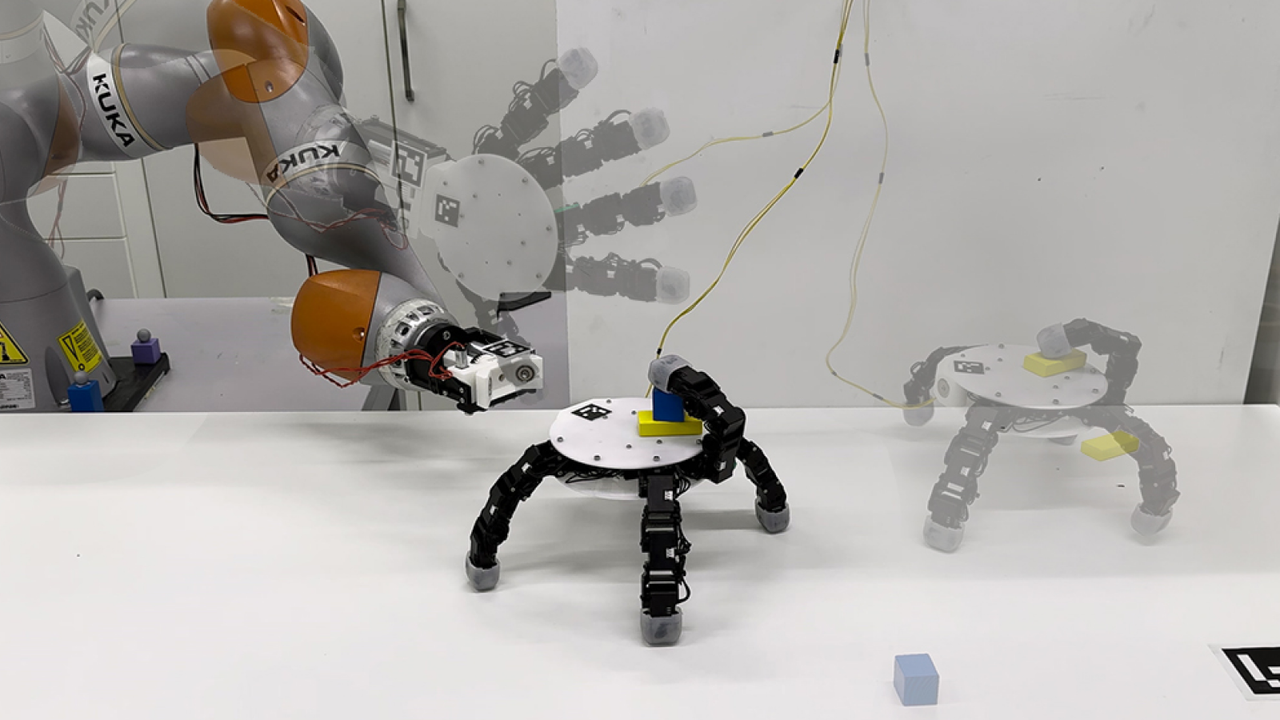
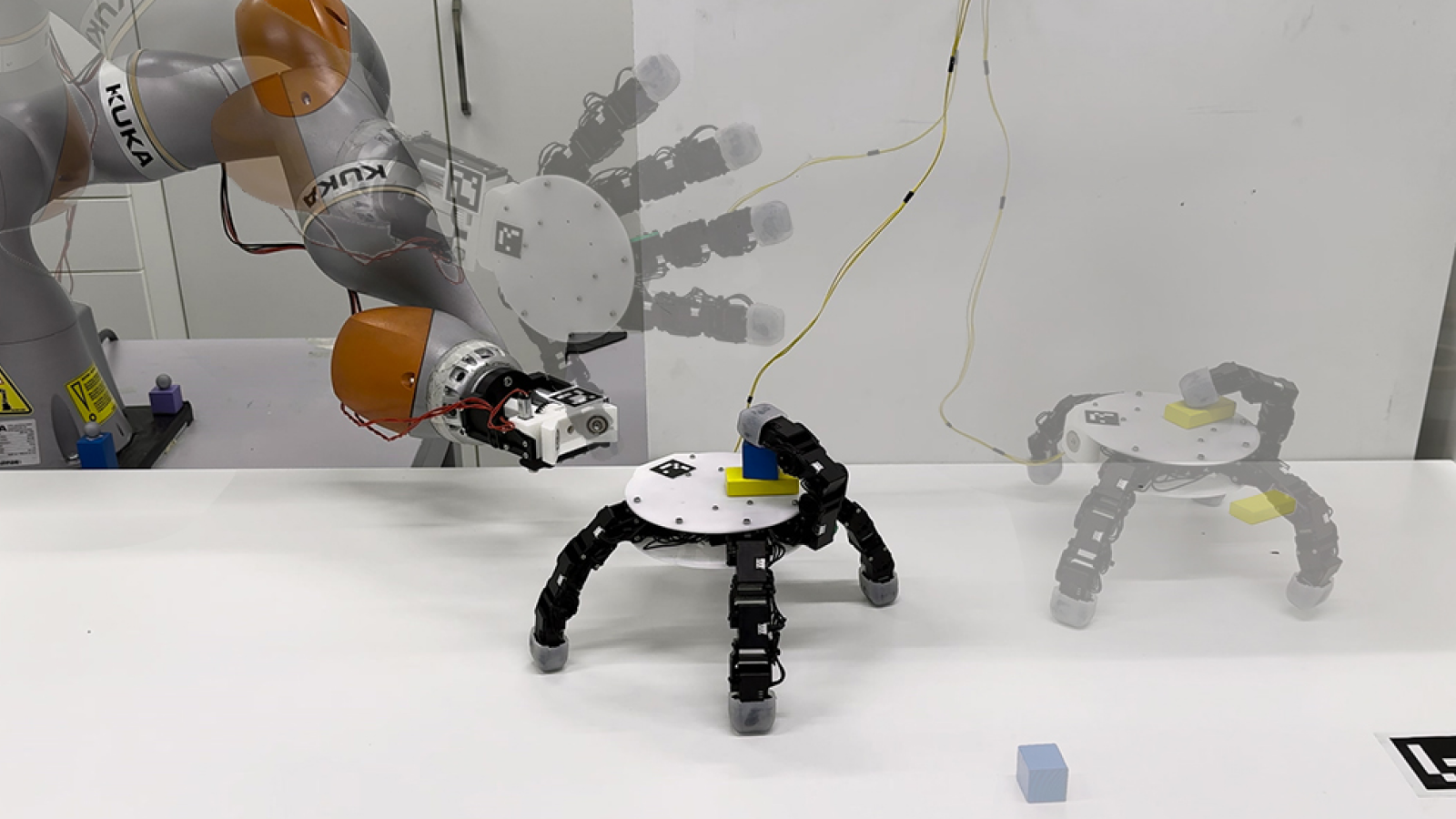
Engineers have built a detachable robotic hand that can crawl into hard-to-reach spaces to retrieve objects.
In a study published Jan. 20 in the journal Nature Communications, scientists at the Swiss Federal Technology Institute of Lausanne (EPFL) said the robot was designed to combine two capabilities that are usually kept separate in robotics: manipulation and locomotion.
You may like-
 New 'Transformer' humanoid robot can launch a shapeshifting drone off its back — watch it in action
-
 Watch: Chinese company's new humanoid robot moves so smoothly, they had to cut it open to prove a person wasn't hiding inside
-
 Bizarre robotic chair concept looks like a crab and can carry you around the house — it can even help you into your car
The hand can also operate without a full, mobile robot base. Instead, it simply detaches itself from a robotic arm and scuttles off to wherever it is needed, picks up the object and returns to reattach itself.
This could make it useful in situations where robots need to reach or retrieve objects from spaces that are too tight or too dangerous for human arms to access, such as industrial or exploratory environments and areas affected by disasters, the researchers noted.
"We can easily see the limitations of the human hand when attempting to reach objects underneath furniture or behind shelves, or performing simultaneous tasks like holding a bottle while picking up a chip," study co-author Aude Billard, head of the Learning Algorithms and Systems Laboratory in EPFL's School of Engineering, said in a statement.
"Likewise, accessing objects positioned behind the hand while keeping the grip stable can be extremely challenging, requiring awkward wrist contortions or body repositioning."
Sign up for the Live Science daily newsletter nowContact me with news and offers from other Future brandsReceive email from us on behalf of our trusted partners or sponsorsBy submitting your information you agree to the Terms & Conditions and Privacy Policy and are aged 16 or over.Handy robotics
Robotic appendages, like hands, have been built before. The human hand is, after all, considered a biological marvel; it's given humans the dexterity needed to make tools, prepare food and build shelter, all of which have proved key to our survival as a species.
Still, human hands do have some distinctly biological limitations, the scientists noted. For example, our asymmetrical thumbs and our hands' permanent attachment to our arms.
EPFL's robot is essentially a self-contained system that can either act like a normal "gripper" on the end of an arm or detach itself and scurry about on its own. The design draws inspiration from nature, with the researchers likening it to how an octopus uses its arms to move across the seafloor and open shells, or how a praying mantis uses its spiked forearms to both move around and catch prey.
You may like-
Bizarre robotic chair concept looks like a crab and can carry you around the house — it can even help you into your car
-
 Humanoid robots could lift 4,000 times their own weight thanks to breakthrough 'artificial muscle'
-
 Tiny spiders that build giant 'puppet' decoys from disembodied prey discovered in Peru and Philippines
In experiments, the researchers demonstrated the hand performing various standard gripping and grasping exercises, as well as accomplishing more fiddly feats of dexterity that humans routinely struggle with. These included holding multiple objects at once or gripping objects without using the thumb or forefinger.
Not only can the robotic hand grasp up to four objects simultaneously, it can also crawl across the floor while carrying items on its "back."
Each of the robot's fingers is driven by small electric motors and linked by lightweight 3D-printed joints, allowing them to curl and spread much like human fingers. Unlike a human hand, however, each finger joint can bend both forward and backward, allowing it to grab objects in both directions and "flip" its working orientation without needing to rotate at the wrist.
The fingertips are capped with a soft silicone layer to add friction, making it easier to hold objects securely and maintain traction when crawling. "There is no real limitation in the number of objects it can hold; if we need to hold more objects, we simply add more fingers," Billard said.
RELATED STORIES—New 'Transformer' humanoid robot can launch a shapeshifting drone off its back — watch it in action
—Watch: Chinese company's new humanoid robot moves so smoothly, they had to cut it open to prove a person wasn't hiding inside
—Scientists create ultrapowerful, squishy robotic 'eye' that focuses automatically and doesn't need a power source
The hand reattaches itself to the arm using a "snap-and-lock" system. Magnets help align the connectors, and a small motor drives a locking bolt that secures the joints.
The system could eventually be adapted for human prosthetics or "extra limb" augmentation, the team said, though this isn't the focus of the current prototype.
"The symmetrical, reversible functionality is particularly valuable in scenarios where users could benefit from capabilities beyond normal human function," Billard said.
"For example, previous studies with users of additional robotic fingers demonstrate the brain's remarkable adaptability to integrate additional appendages, suggesting that our non-traditional configuration could even serve in specialized environments requiring augmented manipulation abilities."
Article SourcesGao, X., Yao, K., Junge, K. et al. A detachable crawling robotic hand. Nat Commun 17, 428 (2026). https://doi.org/10.1038/s41467-025-67675-8
 Owen Hughes
Owen Hughes is a freelance writer and editor specializing in data and digital technologies. Previously a senior editor at ZDNET, Owen has been writing about tech for more than a decade, during which time he has covered everything from AI, cybersecurity and supercomputers to programming languages and public sector IT. Owen is particularly interested in the intersection of technology, life and work – in his previous roles at ZDNET and TechRepublic, he wrote extensively about business leadership, digital transformation and the evolving dynamics of remote work.
Show More CommentsYou must confirm your public display name before commenting
Please logout and then login again, you will then be prompted to enter your display name.
Logout Read more Bizarre robotic chair concept looks like a crab and can carry you around the house — it can even help you into your car
 Humanoid robots could lift 4,000 times their own weight thanks to breakthrough 'artificial muscle'
 Tiny spiders that build giant 'puppet' decoys from disembodied prey discovered in Peru and Philippines
 Snakes' mind-bending 'heat vision' inspires scientists to build a 4K imaging system that could one day fit into your smartphone
 Why can't you wiggle your toes one at a time?
 Tractor beams inspired by sci-fi are real, and could solve the looming space junk problem
Latest in Robotics
Tractor beams inspired by sci-fi are real, and could solve the looming space junk problem
Latest in Robotics
 New 'Transformer' humanoid robot can launch a shapeshifting drone off its back — watch it in action
 Watch: Chinese company's new humanoid robot moves so smoothly, they had to cut it open to prove a person wasn't hiding inside
Bizarre robotic chair concept looks like a crab and can carry you around the house — it can even help you into your car
Humanoid robots could lift 4,000 times their own weight thanks to breakthrough 'artificial muscle'
Watch: Chinese company's new humanoid robot moves so smoothly, they had to cut it open to prove a person wasn't hiding inside
Bizarre robotic chair concept looks like a crab and can carry you around the house — it can even help you into your car
Humanoid robots could lift 4,000 times their own weight thanks to breakthrough 'artificial muscle'
 Scientists create ultrapowerful, squishy robotic 'eye' that focuses automatically and doesn't need a power source
 Watch new humanoid robot pirouette, pose and pull off deft karate moves with eerily lifelike movement
Latest in News
Watch new humanoid robot pirouette, pose and pull off deft karate moves with eerily lifelike movement
Latest in News
 Creepy robotic hand detaches at the wrist before scurrying away to collect objects
 Dark matter and neutrinos may interact, hinting at 'fundamental breakthrough' in particle physics
 Lab mice that 'touch grass' are less anxious — and that highlights a big problem in rodent research
 Californians have been using far less water than suppliers estimated — what does this mean for the state?
 Coyote scrambles onto Alcatraz Island after perilous, never-before-seen swim
 Enormous freshwater reservoir discovered off the East Coast may be 20,000 years old and big enough to supply NYC for 800 years
LATEST ARTICLES
Enormous freshwater reservoir discovered off the East Coast may be 20,000 years old and big enough to supply NYC for 800 years
LATEST ARTICLES- 1Creepy robotic hand detaches at the wrist before scurrying away to collect objects
- 26 tips to kickstart your exercise routine and actually stick to it, according to science
- 3Sega Toys Homestar Classic star projector review
- 4Californians have been using far less water than suppliers estimated — what does this mean for the state?
- 5Scientists may be approaching a 'fundamental breakthrough in cosmology and particle physics' — if dark matter and 'ghost particles' can interact